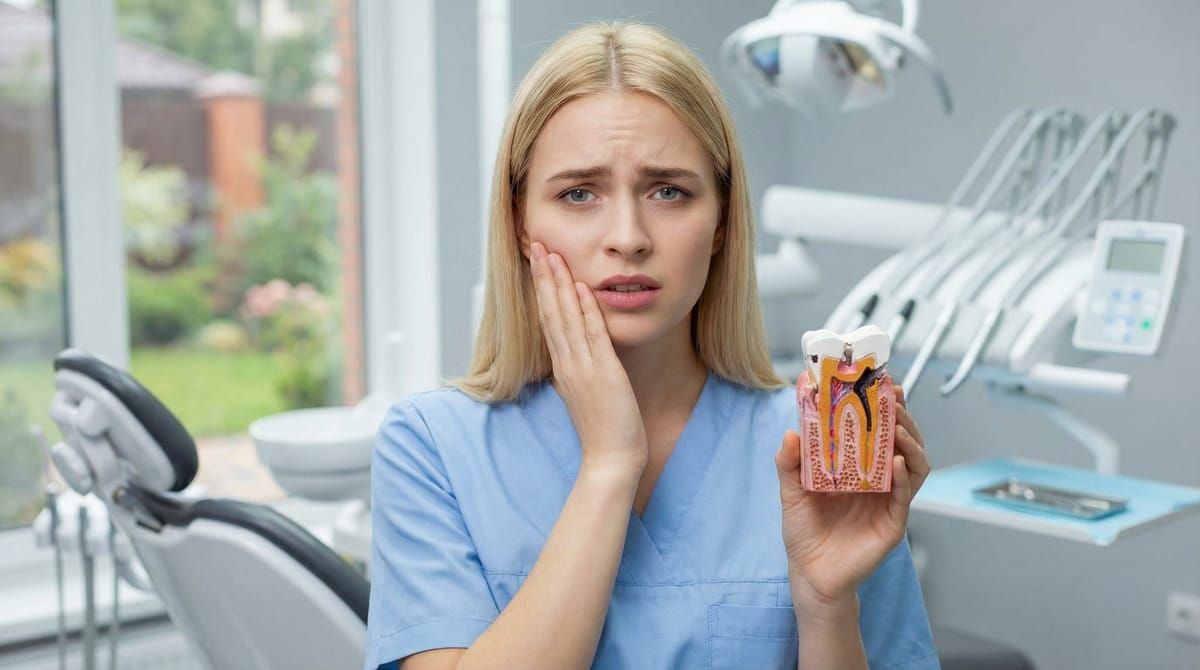
Mild to moderate soreness for 3 to 5 days after a root canal is completely normal, especially when chewing on the treated tooth. The nerve is gone, but the tissues around the root are inflamed from the infection that was there and from the work of cleaning it out. What is not normal: pain that intensifies after day 2 or 3 instead of easing, visible swelling, fever, a bite that feels wrong, or significant pain returning weeks or months later. Normal soreness fades on a downward curve; anything on an upward curve deserves a call to your provider, not patience.
Why a Tooth Hurts After the Nerve Is Removed
The question everyone asks: if the nerve is out, what is hurting? The answer is everything around the tooth. The root sits in a socket of bone and ligament full of its own nerve endings, and those tissues have been through a lot:
- Pre-existing inflammation. The infection or inflammation that made the root canal necessary had already irritated the bone at the root tip. That inflammation takes days to weeks to resolve after the cause is removed.
- Instrumentation soreness. Cleaning canals to their full length works right at the boundary of those tissues. The ligament responds like any tissue after a procedure: tender for a few days.
- A long appointment. Ninety minutes open wide leaves jaw muscles and the joint achy independently of the tooth.
- A high temporary filling. If the temporary sits even slightly proud, every bite hammers the healing ligament. This one is mechanical, common, and fixed in five minutes at the office.
The Normal Recovery Timeline
Hours 0 to 4: numbness fades; dull awareness of the tooth begins. Eat on the other side once sensation returns (more in our root canal recovery guide).
Days 1 to 2: peak soreness. Tender to bite, tender to tap, sometimes a dull background ache. Entirely expected.
Days 3 to 5: clear improvement. Chewing gets comfortable, the ache retreats to an occasional twinge.
Week 2: most patients feel nothing or nearly nothing. Faint sensitivity to firm pressure can persist a few weeks as the bone at the root tip remodels; a slow fade of the last few percent is normal.
Beyond a month: the tooth should feel like any other. Persistent tenderness to biting past 4 to 6 weeks is a "mention it at your crown appointment" item, not an emergency, but it should be mentioned.
How to Ease Normal Post-Root Canal Soreness
- Over-the-counter pain relief as advised by your provider or pharmacist. For typical cases this is all that is needed, and usually only for the first 2 to 3 days. Take what is recommended for you personally, especially if you have other health conditions.
- Chew on the other side until the permanent restoration is placed. The treated tooth is structurally vulnerable as well as sore.
- Cold compress on the cheek in 15-minute intervals during the first day for any puffiness or ache.
- Head elevated the first night. An extra pillow reduces the throb of lying flat.
- Warm salt water rinses from day 2, gently, if the gum around the tooth is tender.
- Skip very hot, very hard, and very chewy food for a few days, and avoid chewing gum on that side.
- Keep brushing and flossing the area normally but gently; a clean site heals faster.
What NOT to do: place any medication or remedy directly against the gum or tooth (burns tissue and helps nothing), drink through the pain with alcohol, or decide on your own to double up on pain relievers. If standard doses of what your provider suggested are not touching the pain, that is information they need, not a dosing problem to solve solo.
Throbbing Pain After a Root Canal: The Warning Pattern
Throbbing deserves its own section because it is the symptom that most reliably separates normal from not. Post-procedure soreness aches; it responds to pain relief; it fades daily. Trouble throbs; it pulses with your heartbeat; it escalates.
Pain Months or Years Later: Failed Root Canals
A properly treated tooth can serve for life, and root canal success rates run around 90 to 95 percent. In the minority that fail, pain, tenderness on biting, or a gum pimple returns months to years later. Causes include missed accessory canals, new decay leaking bacteria past the seal, a cracked root, or a crown placed too late. The options at that point are retreatment (redoing the root canal), a minor surgical fix at the root tip called an apicoectomy, or extraction as the last resort (the trade-offs live in root canal vs extraction). Late-returning symptoms are exactly the scenario where seeing an endodontist rather than waiting pays off: failed root canals are far more fixable early.
FAQ
How long does pain last after a root canal?
Mild to moderate soreness for 3 to 5 days, fading steadily, with faint pressure sensitivity possible for a few weeks. Pain should follow a downward curve from day 2 onward.
How do I stop throbbing pain after a root canal?
First 48 hours: the pain relief your provider recommended, cold compresses, head elevation, and chewing elsewhere. Throbbing that persists past day 3 or worsens is a call-your-provider symptom, not a home-management one.
Why does my root canal tooth hurt when I bite?
Inflamed ligament around the root (normal for days to a few weeks) or a high temporary filling (fixed in minutes at the office). Biting pain past 4 to 6 weeks should be evaluated.
Is it normal to have pain a week after a root canal?
Mild residual tenderness, yes. Significant, escalating, or throbbing pain at one week, no; contact your provider.
Can a root canal fail years later?
Yes, in roughly 5 to 10 percent of cases. Returning pain, swelling, or a gum pimple near a treated tooth warrants an endodontic evaluation; retreatment and apicoectomy save most of these teeth.